Album Review
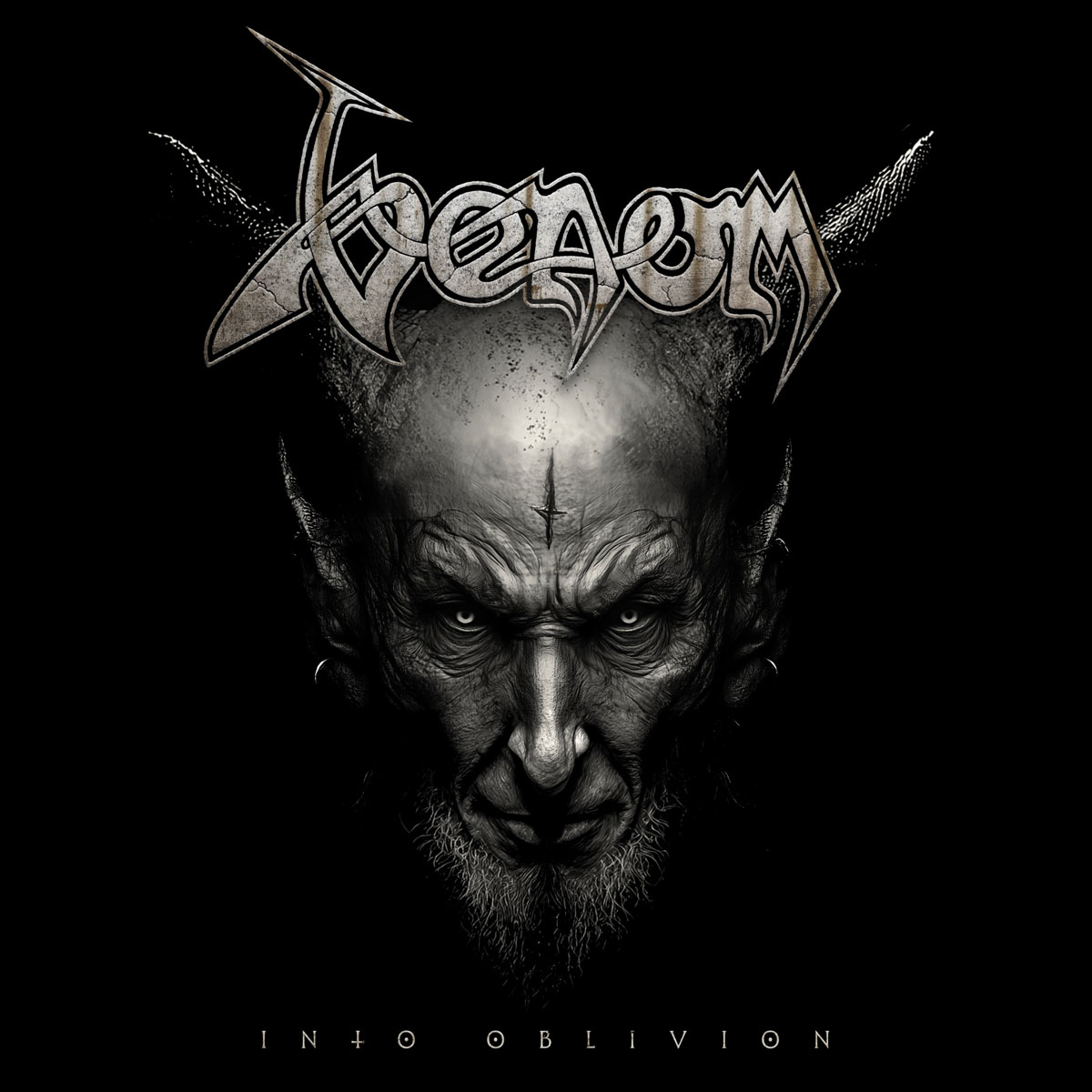
Venom - Into Oblivion
Noise Records
NWOBHM/Heavy Metal, Speed/Black Metal
07/10
Venom may well be the most aberrant and shocking voice to have emerged from the British metal scene. The most feral offspring of the NWOBHM reunite with their fans through their sixteenth studio album, Into Oblivion. In recent years, the name Venom has surfaced in the press through internal disputes among founding members, competing claims over rights, and protracted legal battles—now, at last, they stand before us with a new work.
Time is striking in the way it turns what was once feared and provocative into tradition. Things that were once perceived by outsiders to the metal scene as threatening, subversive, even worthy of censorship—and, within the scene itself, as harsh, angular, even amateurish—now stand like artifacts to be preserved; referenced, imitated, yet no longer truly unsettling. Into Oblivion stands precisely on this fault line: a record by a band that forged the language of extremity and gave a genre its name, now employing that language as something settled, almost fixed in form.
Cronos is not concerned with carrying the grandeur of the past into the present; rather, he continues to exist within a form that still fits. The album, through its title track, briefly steps outside the framework mentioned above—melodic contours emerge—only to contract again into the familiar shape. It momentarily suggests that the space the album occupies could expand. But this possibility is not pursued. The record quickly settles into a recognizable Venom cycle: riffs that evoke a certain era without pushing against it, choruses meticulously engineered for memorability, and structures that deliberately avoid generating expectation.
To be fair, this predictability does not dominate the entire album, but it is consistently felt. “As Above, So Below” is built on a strong foundation, yet loses its impact over time as it is stretched beyond necessity. “Kicked Outta Hell” and “Lay Down Your Soul,” on the other hand, operate more on instinct. Their direct, immediately tangible, even consciously rough-edged construction does its job. However, the calculated nature of these compositions makes their impact zones easy to anticipate. Within their own safe confines, it feels as though their reception is predetermined from the outset.
Still, there are moments that slip beyond this calculation. At times, the guitars create a layered texture that adds distinction. The closing section of the album—particularly “Unholy Mother”—draws the listener into a slower, more controlled space. Here, the priority shifts toward reinforcing the atmosphere the album generates. While these moments do not fundamentally alter its direction, they interrupt its flow just enough to evoke the possibility of an alternative path. Yet Venom show little inclination to fully realize that possibility.
There is also a noticeable duality in Cronos’ vocal performance. At times, he channels a harsh delivery that nearly captures the aggression of a live performance; at others, he moves along more familiar lines rooted in Venom’s traditions. Neither approach overpowers the other. What emerges is less an evolved performance than a coexistence—two parallel tendencies that never fully converge, sharing the same space.
What defines Into Oblivion is not necessity, but continuity. The production preserves a certain grit and abrasion, avoiding the kind of modern sterility that would sand down its character. The pacing fulfills its function. Even when the material fades at points, the album does not collapse under its own weight. Yet it shows little desire to take steps that might lighten that burden.
This is not an album attempting to reassert the importance of a career that spans decades. It does not need to. Its confidence is drawn directly from the legacy it stands upon, with a firm belief that this foundation remains sufficient. For those still aligned with that ground, it may register as consistency—even a form of reassurance. For others, it may feel like witnessing a language still spoken fluently, long after much of its capacity to surprise has eroded.
Into Oblivion is an album that consciously refuses excessive visibility, choosing instead to remain within the form it once shaped, without stepping beyond it.
OZY