
Album Review
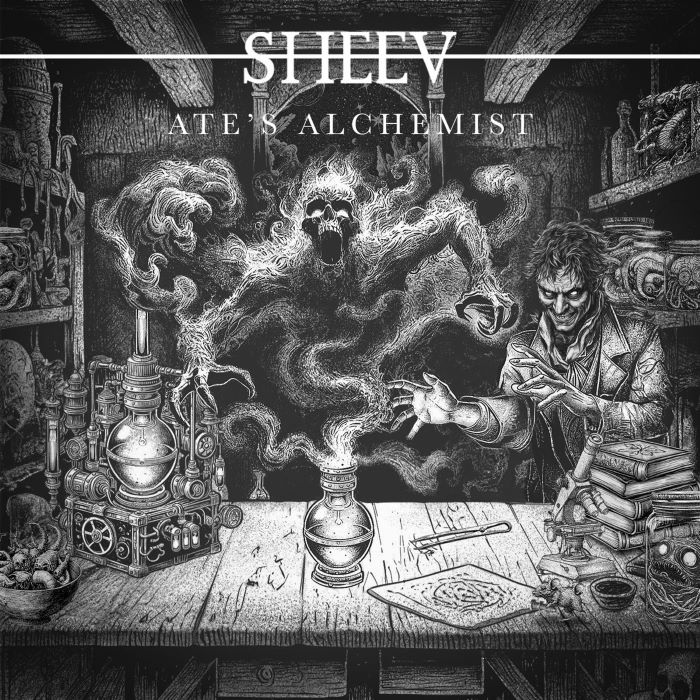
SHEEV - ATE'S ALCHEMIST
Sheev’s second album Ate’s Alchemist transforms an unrestrained inner tremor into a constructed narrative, from the first note to the final reverberation. This eight-track journey, each song prying open a different gate to hell, pulls the listener into the very core not only of sound, but of story and anxiety itself. Breaking a four-year silence, this Berlin-based outfit’s new record is neither a simple follow-up nor merely another variation of “stoner metal”; it is a dark alchemical ritual—its name drawn from a mythological bearer of curses—holding a mirror to humanity’s most ancient fears.
In sonic terms, the album melts doom’s primordial shadow with the desert winds of stoner into a single crucible. Yet it does more than oscillate between genres—it deftly redraws their boundaries. Mastodon’s animalistic aggression, Alice In Chains’ ice-cold melancholy, and Tool’s rhythmic unease course through the veins of different tracks. Still, Sheev never becomes a puppet to these influences; instead, they transmute them into a formula of their own—true to their name, like an alchemist.
Opening track “Martef” sets the album’s emotional tone: aggressive yet calculated, groovy yet razor-sharp. It feels like standing in the middle of a collision between Mastodon and Queens of the Stone Age. What follows, “King Mustard II,” channels this energy into something both more introspective and more complex—arguably one of the record’s most identity-defining pieces. The riffs are at times stacked with near-mechanical precision, yet this sense of mechanization is consistently balanced by progressive transitions and interwoven melodic layers, maintaining an unmistakably human intensity.
“Henry” is a melodic movement anchored in doom’s dark mass. Here, the bass guitar acts almost like a narrator, steering not just rhythm but mood itself. Particularly in this track, classic stoner formulas are pulled toward a more theatrical, almost post-metal narrative. Then comes “Cul De Sac,” the beating heart of the album. Spanning nearly eight minutes, it merges Tool’s spiraling structures with Mastodon’s feral nature. What stands out most, however, is the dramatic power of multi-layered vocal harmonies—echoing both Opeth and Alice In Chains—resulting in something that feels like a march, both melodic and devastating.
One of the album’s more divisive tracks, “Tüdelüt,” may leave listeners conflicted with its complex structure and angular riff patterns. Yet this is precisely where Sheev’s intent to create “deliberate discomfort” becomes evident. The track exposes the album’s unsettling undercurrent just as clearly as its more gratifying aspects. Closing piece “Sabress” serves both as the final destination and a moment of rebirth. With its majestic riff progressions, dramatic choral touches, and epic sense of closure, it resembles a lament—but not for loss; rather, as a declaration of awareness.
On the production front, Karl Daniel Lidén (The Ocean, Bloodbath) makes his presence felt: every instrument sits exactly where it should, dynamic ranges are clearly defined, and the guitar tones are saturated without becoming suffocating. Perhaps the album’s greatest strength lies here—crafting density without exhausting the listener, presenting layered compositions not as something “difficult,” but as something intriguing.
Ate’s Alchemist expresses a mythological narrative through a modern metal language, inviting the listener not only into rhythm, but into a search for meaning. What Sheev achieves here is not merely technical proficiency in composition, but the articulation of an inner collapse. Each track feels like part of a chemical experiment—some explosive, some unresolved, others quietly burning.
This is not an archive; it is a process. And within that process, every listen reveals a new fragment. Telling a story of transformation from beginning to end, the album resonates not only in the ears, but within the inner chambers of the self. Sheev’s alchemy seeks not gold, but truth.