
Album Review
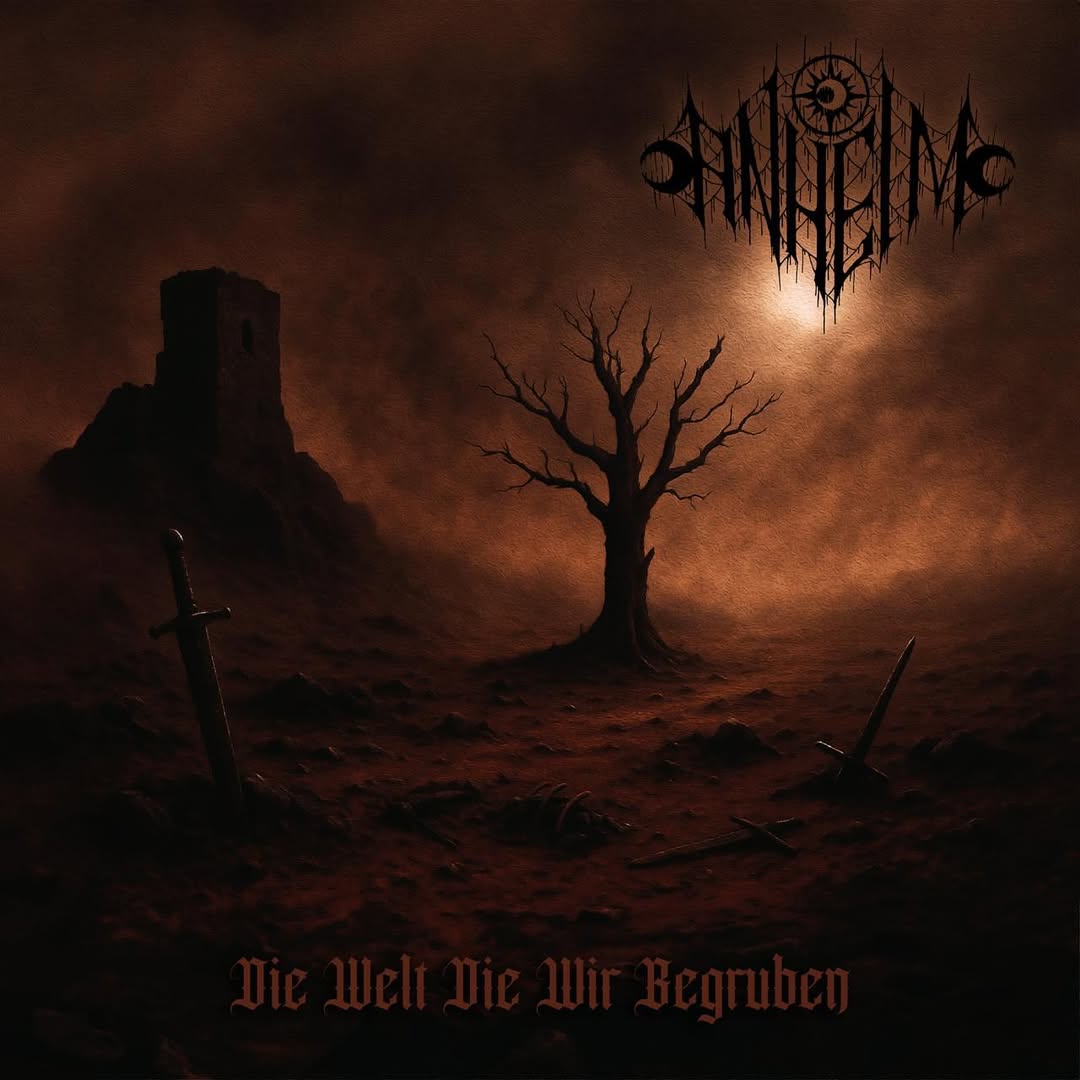
ANHEIM - DIE WELT DIE WIR BEGRUBEN
Independent
Black Metal
09/10
Some albums speak not with their opening notes, but with their opening silence. Die Welt Die Wir Begruben does more than establish a dark atmosphere; in constructing it, every instrument, every word in the lyrics—even every void—is chosen with meticulous care. Hailing from Würzburg, Anheim aren’t merely taking a musical step with this album; they are also digging their own internal gravestones. Each track recounts the residue of a buried world—or rather, calls on us to confront it.
The opening track, “Galgenbaum,” does not behave like a conventional intro. Expressionist guitars and pressing drums carry not a “welcome,” but a whispered “you cannot escape.” Andergrout’s feral vocals signal not a chaotic rage, but a systematic, calculated, and patient collapse. As the album unfolds, this sense of control does not dissipate; instead, it coils inward with each successive track.
“Roter Staub” stands as the album’s cornerstone. Beginning at the edge of an inner deluge, the track transforms into a destabilizing journey, constantly shifting its tempo and intensity. The bass guitar assumes a role beyond typical black metal conventions: not merely a rhythmic tool, but an emotive narrator. The calm that emerges midway through the piece, followed by its tearing transitions, creates an almost cinematic structure. This is not just technical proficiency—it is a command of dramatic construction.
On “Ascheschrein,” an experimental atmosphere emerges through organ touches and a recessed vocal mix, gradually morphing into a tense savagery. Here, the guitars seem less concerned with drawing melodies than with erecting a structure—like a wall of dread built brick by brick. The sudden acceleration toward the end feels like a collapse, as if the entire structure caves in on itself.
“Sonnenseher” is one of the album’s most stripped-down yet striking moments. Opening with doom-laden textures, the track uses tempo shifts as a direct tool of dramatic expression. Neither lacking nor excessive: the melody does not scream, yet it asserts itself, occupying precisely the space it needs. This restraint does not lighten the album’s thematic weight; on the contrary, it lends it a more threatening depth.
On “Silbernes Haar,” the band merges contrasting vocal colors—female vocals and shrieks—within a dramatic framework. Driven forward by a militaristic drum march, the track stands out for its atmospheric depth. At times approaching post-metal through its rhythmic fractures, it evolves into what feels like the music of an inner ritual, especially with the solo that enters midway. What truly stands out here is a mode of expression that avoids technical showmanship, yet still feels grand.
The production details are equally capable of carrying this narrative: shaped by the touch of P.G. (Groza), the soundscape offers a mix that is both cold and clear, yet constantly pressing in on the listener. No instrument overwhelms another, yet none recede. Vocal effects are used sparingly, serving only to intensify the darkness without excess. The guitar tones provide not just melodic structure, but a kind of texture—spreading over each track like a blood-colored mist.
Thematically, the album is concerned not only with the act of burial, but also with the identity of the one who bears witness to it. Anheim do not portray an external darkness, but the silence of an internal decay. For this reason, no moment on the album offers a conventional eruption or catharsis. What is being conveyed is not a state that reaches resolution, but one that accepts its own irresolution.
The final track, a bonus recording, nods to the band’s earlier period while revealing where this transformation began. It feels less like a conclusion and more like a renewed act of excavation.
Though Die Welt Die Wir Begruben may reside within melodic black metal in genre terms, musically it exists outside of time. Neither retro nor progressive—it simply inhabits its own era, its own decay. Anheim are no longer just a band, but a form of memory echoing among gravestones. It is not easy to listen to, and even harder to digest. But for those who truly seek to feel, this album stands as one of the most intimate whispers of the contemporary black metal landscape.