Album Review
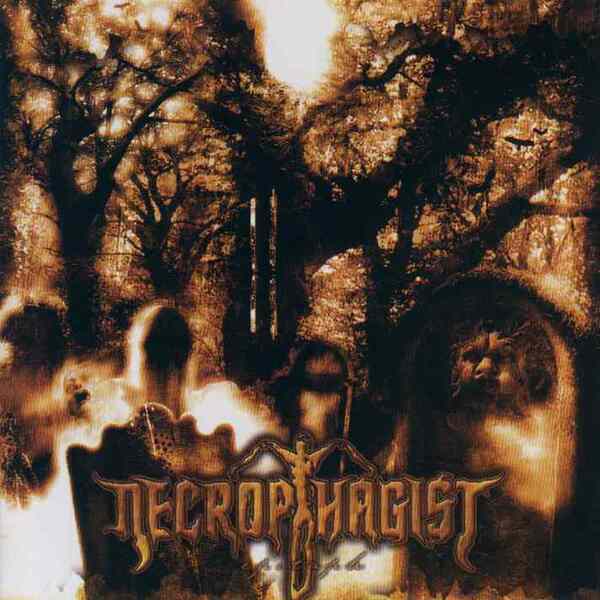
Necrophagist - Epitaph
Relapse Records
Technical Death Metal
There is a crucial detail that separates technical death metal from other branches of the genre; once you reach its threshold, the music and melodies we’re accustomed to begin to withdraw, and what remains in the landscape is a closed system. A structure that speaks inwardly, flawlessly sealed, impressive yet waiting to be discovered—one that does not invite the listener inside. Epitaph stands exactly on that threshold. It doesn’t fully cross that line, but it lingers there for precisely as long as it decides, constructing its own reality in the process. Then comes the inevitable question: how much virtuosity can a composition still carry?
Necrophagist approach this boundary with such confidence that it possesses a quality capable of both unsettling and provoking envy among their peers. The album is built upon such immaculate precision that at times it feels almost inhuman. The guitars don’t play riffs; they break sound apart, dissecting it on a molecular level and leaving behind motions that feel sterile, almost as if isolated in a laboratory environment. The production is one of the key factors that makes this unmistakable. Every note is heard on its own—clear, visible, open to analysis. There is no blur to hide behind, no unnecessary density to soften the edges. You hear everything, and that is precisely where the album’s allure lies. Considering the technological limitations at the time it was recorded—far from the flexibility we have today—and the fact that Muhammed Suiçmez and Christian Münzner worked in a damp basement with limited recording software, repeating takes countless times and meticulously crafting the mix piece by piece, it becomes easy to believe that such a result could only emerge from a process that relentlessly tests human patience and nerves.
What is truly striking is how these intensely complex yet equally clear riffs manage to leave an immediate imprint on the mind. We are not talking about traditional catchy riffs; these are not melodies you hum, but they settle into memory as forms rather than tunes. Passages unfolding on an unprecedented mathematical plane progress with a kind of ingenious logic; if you are not familiar with this language, they resemble mechanisms whose workings you cannot fully grasp, yet once you see them function, they feel strangely recognizable—an effect that grows more compelling with each passing second. The opening makes this immediately clear: from the very first solo of “Stabwound,” a structure emerges that holds the listener captive.
At times, this structure ceases to feel like a composition and turns into a demonstration. While the guitar work may have been perceived at the time of release as focused on proving its own difficulty, today it is easier to understand that Muhammed Suiçmez conceived and executed all this craftsmanship with the ease of someone conversing with the listener. It is a dangerously addictive form of complexity—dense, yet at the same time fluid.
What is interesting is that the entire band seems aware of this tension and skillfully directs that high energy. The relatively slower moments on the album are proof of this. Brief, but highly effective passages. In these moments, the album does not take a conventional death metal breather—it inhales. The chaos and high energy carried up to that point do not disappear, but they loosen, allowing the album’s character to shift into a more refined dimension. And within these loosened contours, details you had not previously noticed begin to reveal themselves.
As for the vocals, it is fair to say that the entire vocal performance is etched as an additional stripe on Muhammed Suiçmez’s epaulettes. With metal musicians occupying the guitar-vocal position, one typically expects a compromise in the fine craftsmanship of one role while executing both. Among extreme metal musicians, figures like Chuck Schuldiner stand out as rare individuals who excel at both. On this album, it is true that Muhammed Suiçmez brings his guitar work more to the forefront; however, through his vocal writing and his decisions on how the lyrics move between riffs, he also leaves his mark on the execution of technical death metal from this perspective. At around thirty-three minutes, had this album been any longer, it would undoubtedly have lost much of its impact. With a structure reminiscent of a magnificent feat of engineering, the album asserts this distinction through its duration as well. It is precisely at this point that the level of intensity Suiçmez chooses for the vocals stands out as an important detail. Some critics at the time argued that the vocals were monotonous, yet had Suiçmez extended them further or attempted to diversify them, this album would certainly not have retained the level of impact it holds today.
After your first listen to Epitaph, what remains is not a specific riff or moment, but the sensation of having observed something crafted with extreme precision. The kind of pleasure you get from staring at a painting that has defied centuries, the feeling of not knowing which scene to begin with when trying to describe a film you love to a close friend. Despite the countless remarkable details it contains, it still creates a hunger to return to it again.
Led by Muhammed Suiçmez, this lineup elevated technical death metal several steps beyond where it stood at the time of the album’s release, granting it a level of prominence it would never again reach. Beyond everything else, the fact that Muhammed is one of us—and that we have the chance to speak with him in our own language, beginning with the familiar question, “So, when is the third album coming, man?”—adds a uniquely personal distinction for many Turkish metalheads like myself. This connection, layered onto the album’s already singular stature, places Epitaph in a truly unparalleled position within the global metal scene. No matter the year, Epitaph will be remembered as an album that caused a rupture in the scene, pushing technical death metal to a point that feels, even now, insurmountable.
OZY