
Review
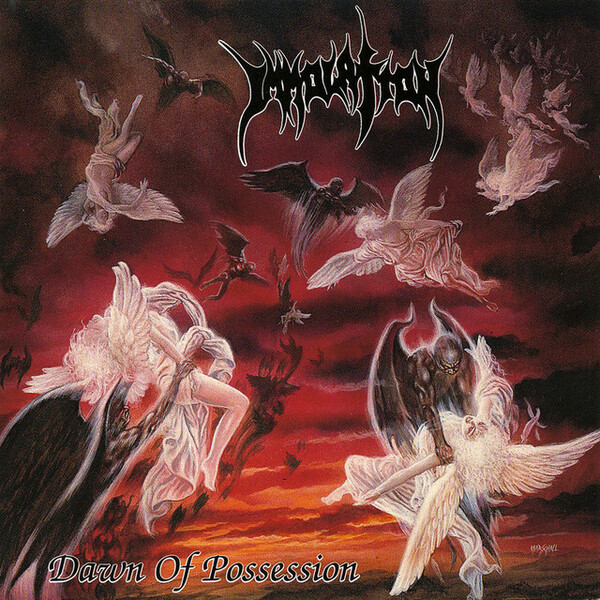
Immolation - Dawn of Possession
R/C Records
Each legendary album in Death Metal serves as a key, unlocking hidden doors in the collective memory of the genre. Immolation's Dawn of Possession swings open the gates to the dark underground of 1991. It stands as a passage into the subconscious of death metal itself—a conduit where rebellion, devastation, and the revolutionary touch of extreme metal echo through every riff. This debut, released in 1991, is not merely a milestone in the genre’s evolution but a work that helped shape its very spirit. Even today, it remains fresh, unsettling, and compelling with a perverse allure, shining as one of the most essential recordings in the death metal archive.
At the core of the album lies structural darkness and a kind of mathematical terror. Vigna and Wilkinson’s guitars transform into a rhythmic mind game; each riff is jagged and slippery. The compositions don’t lean on neoclassical grandeur—they advance with a geometry that seeps directly from the gates of hell. Particularly, Into Everlasting Fire’s 6/4 time signature, hinting at "666," is laden not just with precision but with symbolic depth. The rhythmic distortions challenge not only the senses but the mind itself. This music is not “smooth” in any conventional sense—it’s a deliberately stumbling, menacing beast.
Ross Dolan’s vocals carve through the album like a curse, almost entirely monolithic in tone. Yet this choice is far from monotonous; it anchors the chaos of the music, creating a pivotal fulcrum. The religious devastation in the lyrics isn’t born of blind hatred—it’s delivered with deliberate, structured intent. Tracks like Those Left Behind and No Forgiveness (Without Bloodshed) deliver a systematic rebuke against the Catholic Church and religious authority, each song like an excommunication writ, an expression of inner deviation made tangible.
Craig Smilowski’s drumming transcends mere technicality, carrying the spirit of the compositions themselves. The drums often operate as a narrative voice in their own right, sometimes eclipsing the guitars, almost acting as a third stringed instrument. On Despondent Souls, the rhythmic variations trap the listener in a relentless loop. The bass, though buried in the mix, completes the interplay between components; unseen, yet palpably menacing.
Production-wise, Dawn of Possession embodies the raw authenticity of the early ’90s. Harris Johns’ work at Musiclab in Berlin is one of those rare achievements where clarity coexists with grit. Everything is in place without being sterile; the music cuts through the dust-filled air like a razor in a dimly lit room. This balance forms the foundation of Immolation’s ability to remain technical without sacrificing soul.
The compositions themselves are far ahead of their time. Internal Decadence depicts the rot of the human interior, while Burial Ground portrays humanity as a collective cadaver. The eponymous closing track, Immolation, bears the band’s signature like a final stamp. The album spirals back upon itself, reconstructing its inner collapse with each turn.
For all these reasons, Dawn of Possession succeeds not only technically but emotionally and philosophically. While Immolation would explore other directions in later works, the raw, primal energy of this debut remains unmatched. As a band’s opening statement, it is devastatingly powerful—a seal hammered squarely into the heart of the Death Metal scene.