Album Review
LORD BELIAL - UNHOLY TRINITY
Hammerheart Records
Black Meetal
8.5/10
Unholy Trinity feels like a 2025 seal cast in defiance of absolute nothingness. Not only did Lord Belial break a 14-year silence with Rapture, but returning again after just three years with a new album transforms these Swedish veterans into something closer to a living myth. Yet what truly sets this release apart is this: this isn’t an album born out of fan pressure or the momentum of a comeback. It feels like a distortion of time itself—like the past has been dragged, kicking and screaming, into the present. For the first time since 1999’s Unholy Crusade, Lord Belial sound this defiant, this furious, this genuinely lethal.
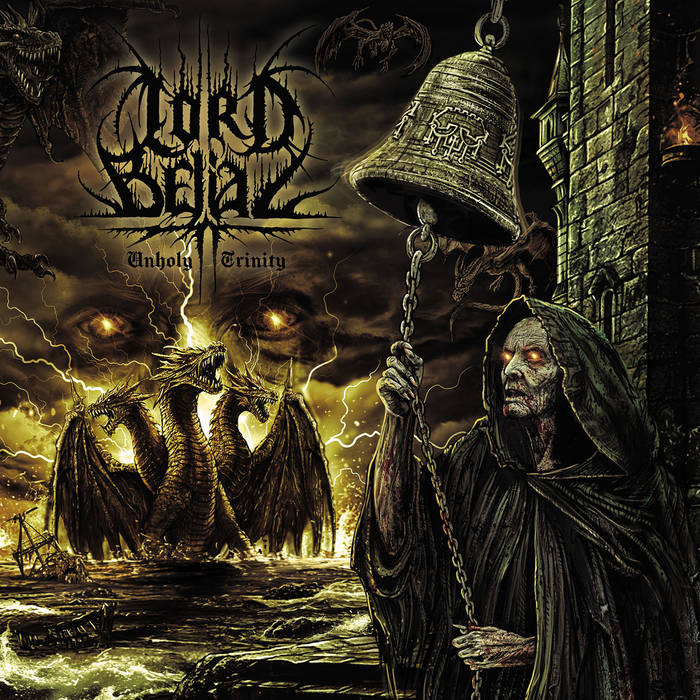
There’s a sharp contradiction between what the album’s title and artwork suggest and what the music actually delivers. Multi-headed dragons, eyes in the clouds, zombies crawling across bell towers… all that gothic-fantasy excess turns out to be a kind of misdirection. Because Unholy Trinity isn’t introspective—it’s pure outward force. Direct, unflinching, and emotionally explosive. The band makes that clear from the opening track, “Ipse Venit.” What unfolds is a meticulously calculated destruction: an unbroken tremolo vortex, relentless blast beats, and a sense that you’re being dragged before something ancient—something that does not belong to the mortal world.
Despite its relentless aggression, the album never collapses into monotony. “Serpent’s Feast” introduces haunting choral layers that create a suffocating kind of hypnosis, while the mid-sections of “Blasphemy,” drawing from a thrash-rooted backbone, inject a warped sense of grandeur into the chaos. “In Chaos Transcend” stands as the structural peak of the record—not just because of its sheer violence, but because of how it weaves melodic transitions into that violence, creating something both ritualistic and anarchic at once.
Vocally, Lord Belial refuse to settle into a single lane. Instead of sticking to the traditional black metal scream/whisper dynamic, the album unfolds as a multi-layered narrative. At times it feels like an internal monologue (“Antichrist,” “In Chaos Transcend”), while elsewhere it morphs into a nightmare dialogue of overlapping, differently toned growls (“Glory to Darkness”). This range doesn’t just add texture—it pulls the listener inward, toward the void within, and outward, into the vastness of nothingness beyond.
On the instrumental side, it’s clear the band has moved on from the more melodic and textured approach of their late ’90s era. But even within this intensified brutality, there’s precision at work. “Scornful Vengeance,” with its subtle clean guitar touches, briefly nods to the past. In that sense, the album feels like a conversation across decades—one that challenges its own history without ever surrendering to it.
That said, the production is arguably the album’s most divisive element. While the guitars carry a biting, aggressive edge, the density of the mix can at times feel overwhelming. The hi-hats and crash cymbals sit unusually high, and this becomes especially noticeable on headphones. There are moments where the sound leans toward chaos—not in intent, but in execution—giving parts of the album a slightly unfinished or rushed feel.
And yet, none of this diminishes what Unholy Trinity ultimately proves: why Lord Belial still matter. Because this isn’t just about resurrecting the ghosts of a genre—it’s about restoring its flesh and bone. This album stands in quiet rebellion against a black metal landscape often diluted into “post,” “gaze,” or “depressive” niches. It’s not simply a return to the roots—it’s a reminder that those roots are still alive, still breathing, and still capable of defining what the genre truly is.
Closing track “The Great Void” seals the album shut like a coffin lid. As the final notes fade, the darkness doesn’t just linger—it leaves a mark, both in substance and in emptiness.
If your introduction to black metal came through the second wave of the Swedish scene, or if you still crave the raw, destructive spirit of the ’90s, Unholy Trinity won’t just meet those expectations—it will break them apart and rebuild them from within.
And perhaps the most striking thing of all: more than three decades in, Lord Belial still sound this angry, this passionate, this alive. That alone feels like a miracle—one that borders on a curse.