
ALBUM REVIEW
BONJOUR TRISTESSE – Disaster Triumphant
Depressive black metal meets philosophical social criticism.
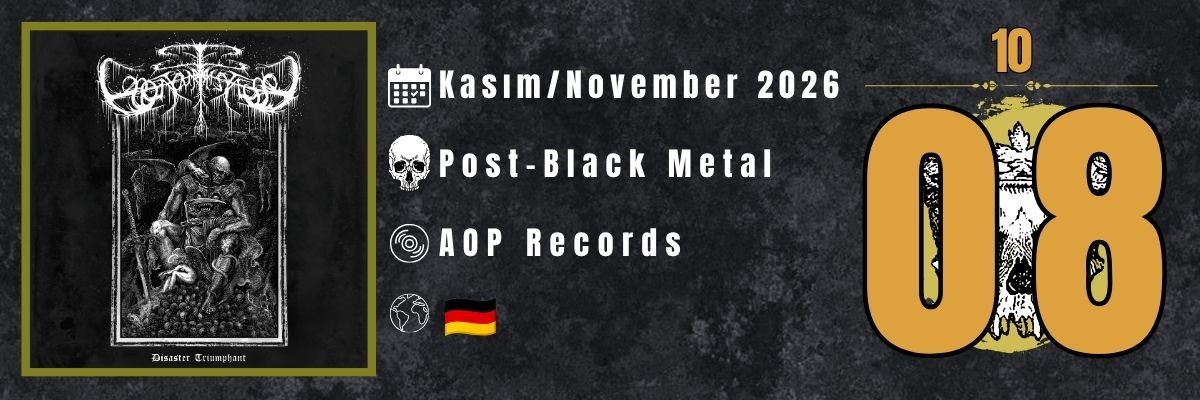
The German black metal scene… Discovering its hidden gems can sometimes feel like reaching a place uncovered only after crossing remote, hard-to-reach landscapes. At other times, it feels like discovering a secret street you’ve passed countless times without ever noticing, where faint lights illuminate a mystery concealed in winter’s dark grey shades. From the very first listen, “Disaster Triumphant” takes me on a journey between these two contrasting sensations. The darkness that runs through the album is more than an attempt to establish a thematic backbone that defines the music’s emotional character; it is also part of a philosophical critique of how humanity, through its own understanding of progress, has made the world increasingly uninhabitable. The project Nathanael launched in 2008 turned towards a more modern, urban-centred post-black metal aesthetic with 2018’s “Your Ultimate Urban Nightmare”, before developing a harsher, faster and angrier mode of expression on “Against Leviathan” and “The World Without Us”. The fifth full-length, due out on 20 November 2026 via AOP Records, revisits the connections with the debut album “Par un sourire” in the wake of this evolution. Here, however, returning to the past is less about retreating into the safe territory of a tried-and-tested formula and more about approaching the long-form songwriting of depressive black metal through different melodic choices and a heavier mode of expression.
The album’s intellectual framework draws on Max Horkheimer and Theodor W. Adorno’s Dialectic of Enlightenment. The idea that Enlightenment, originally intended to free humanity from religious dogma and superstition, has produced new forms of domination through technological progress and industrial civilisation emerges as a central contradiction in BONJOUR TRISTESSE’s lyrics. Humanity’s positioning of itself above nature, its reduction of the world it inhabits to a consumable resource, and its willingness to threaten life in the name of progress all fuel an anger that extends beyond personal sorrow. Loss, mourning, alienation and the desire to withdraw from people form other parts of this intellectual foundation. In doing so, the expressive territory of depressive black metal, traditionally associated with individual helplessness, expands into a critique directed at humanity’s collective responsibility.
The musical counterpart to this approach lies not so much in the speed and aggression that came to define the previous two albums as in compositions that move slowly and unfold across extended stretches of time. Opening track ‘The Heights of Despair’ draws the listener into the album’s world with dark guitar tones and piercing, high-pitched screams, while its melodic lines provide a lasting foundation. Crucially, the guitars do not treat melody as mere decoration placed between aggressive riffs. Melodic motifs keep resurfacing throughout the extended passages, maintaining the track’s emotional continuity. This approach brings its depressive character into sharper focus without diminishing the music’s harshness.
‘At the Mountains of Silence’ develops a similar approach through a heavier, more measured rhythmic flow. Repeated guitar motifs shape the track’s progression, while the sharpness of the vocals creates a persistent sense of unease over this controlled movement. The rhythmic intensity suddenly rises as blast beats kick in, turning the weight sustained up to that point into a brief outburst. The music then slows down again, using the acceleration not as a spectacle in itself but as a means of reinforcing the track’s emotional tension. The transitions between melancholic melodies and harsher black metal passages allow BONJOUR TRISTESSE to bring two distinct modes of expression together within a unified songwriting approach.
The album’s guitar work follows a line that moves between melodic post-metal and atmospheric black metal. Extended solos and prominent lead guitar passages broaden the repetition-based structure of the riffs, while sections driven by tremolo picking and blast beats reveal the music’s rawer side. The high-pitched, anguished vocals establish a consistent expressive thread between these two extremes. The production’s dark, raw character does not completely obscure the melodic qualities of the guitars; instead, it creates a clear contrast between the emotional openness of these melodies and the harshness of the vocals. Brief synth touches and the clean guitar passages used in the finale also introduce a limited but meaningful degree of variety within this overall texture.
Still, the album’s lengthy compositions demand not only patience from the listener but also a willingness to engage with the pressure generated by repetition. While sustaining riffs for extended periods intensifies the atmosphere, it can also narrow the scope for musical development. In particular, keeping the same motif in place for minutes at a time can suspend the music’s progression rather than gradually heightening the tension. Although repetition serves a purpose in conveying the alienation and hopelessness associated with depressive black metal, not every extended passage is equally effective. Greater rhythmic or melodic variation could have made the stillness more meaningful in some tracks rather than weakening their impact.
The title ‘Tomb of Hope’ directly evokes a contradiction at the heart of the album’s intellectual landscape. Placing hope and the grave side by side brings together humanity’s desire to distance itself from a world in decline and the increasingly narrow prospect of salvation. Occasional flashes of brighter expression within the track’s melodic texture do not dispel its prevailing pessimism. On the contrary, the musical space closes in again after these brief moments of openness, conveying just how fragile hope remains. ‘Lingering in the Twilight of Shadows’, meanwhile, steps away from the album’s dense guitar and vocal arrangements for a brief keyboard interlude. Rather than establishing an atmosphere of its own, this passage serves to maintain the dark continuity between the longer compositions through a different tonal colour.
The closing track, ‘Disaster Triumphant’, brings the album’s depressive and harsher elements together over its approximately twelve-minute runtime. Sections driven by blast beats, anguished vocals and instrumental transitions prevent the track from becoming confined to a single dynamic level. Even so, the overall structure retains a sense of progression towards dissolution. The clean guitars used at the close open up a different expressive space within this dark whole. Bearing the album’s title, the track conveys the contradiction between the promise of liberation offered by Enlightenment and the destruction wrought by modern civilisation through its musical dynamics as well as its lyrics.
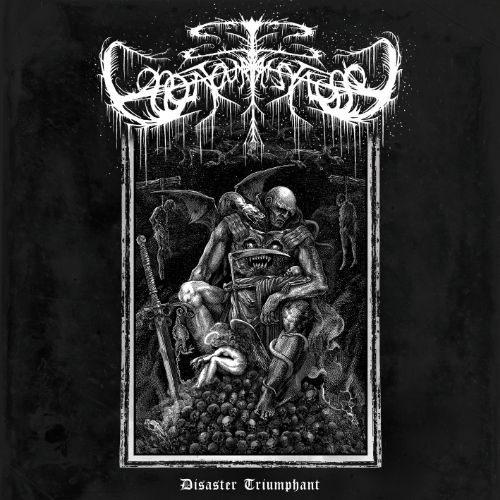
The cover artwork by Abismo Black Arts completes this intellectual framework on a visual level. A tormented figure seated atop skulls representing humanity, cradling Death in its lap and surrounded by dark forces, transforms civilisation’s relationship with the destruction it has brought upon itself into a symbolic narrative. The artwork’s direct, sombre language reinforces the connection the music establishes between personal sorrow and social criticism. The album’s aesthetic coherence thus extends beyond its sonic world to encompass its visual language.
“Disaster Triumphant” sees BONJOUR TRISTESSE return to the long-form, repetition-driven and melodic expression of depressive black metal after the faster, angrier direction of its more recent work. Compared with the harsher, more dynamic songwriting of the band’s previous albums, this shift opens up a more traditional territory and may therefore offer limited appeal to listeners looking for radical innovation. Nevertheless, the album gains a more distinct direction than the genre’s usual pessimism by combining its critique of industrial civilisation with personal helplessness and tying this intellectual weight to slowly unfolding guitar motifs. Although the repetitions occasionally run on longer than necessary, limiting the impact of this approach, “Disaster Triumphant” remains a meaningful work for listeners seeking depressive black metal that brings emotional intensity together with social and philosophical inquiry.

facebook.com/bonjourtristesseofficial
aoprecords.de
facebook.com/aoprecs
artofpropaganda.bandcamp.com